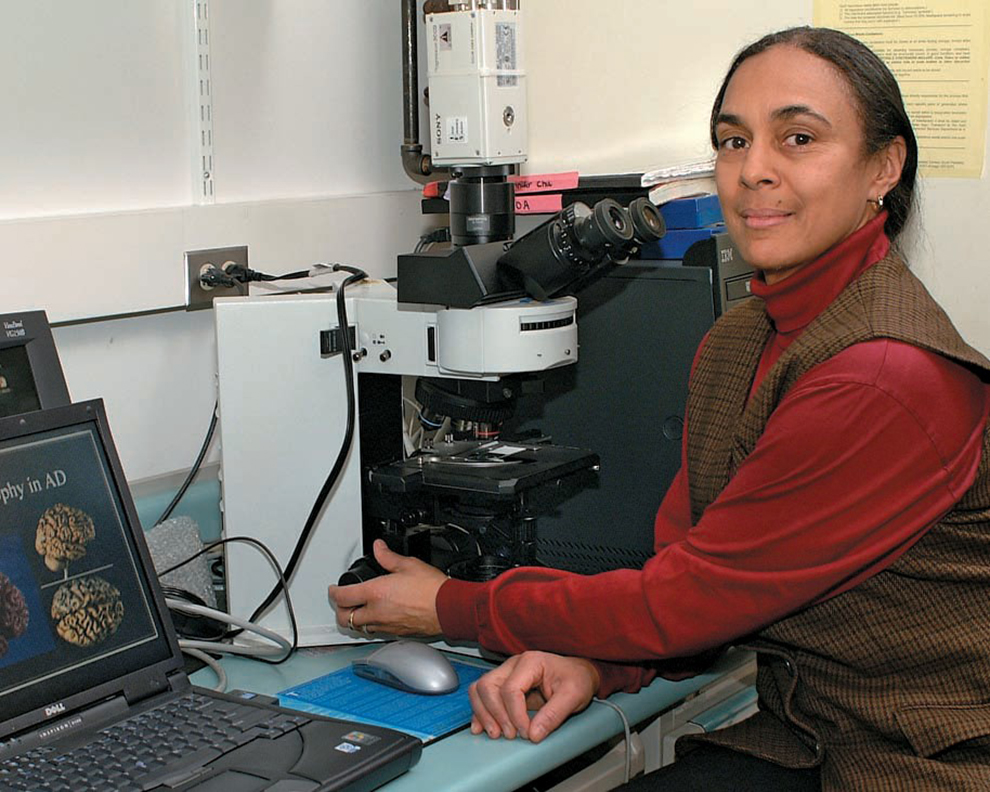
Photo credit: Robin Blossom
As populations of developed countries live longer and longer lives, a perfect storm is brewing that could wreak havoc on public health. While advances in health care have improved life expectancy, diseases of old age will soon affect increasing numbers of people. In fact, by the year 2050, it’s projected that 15 million people will be affected by Alzheimer’s disease. The indirect and direct costs of Alzheimer’s, which are already calculated at approximately $100 billion per year in the United States, will climb proportionately.
One of the hottest breakthroughs in understanding the etiology of Alzheimer’s points to a new culprit causing the devastating effects on the brain, as well as to a new and highly promising therapy: insulin. And some of the leading research is coming out of a lab at Brown Medical School and Rhode Island Hospital.
Type 3 Diabetes
Dr. Suzanne de la Monte, professor of pathology and laboratory medicine (research), is a neuropathologist at the Liver Research Center and the Department of Clinical Neuroscience. For years she has studied the effect of alcohol on neurodegeneration, the gradual death of neurons in the brain. She began looking at the role of insulin in the brain in relation to alcohol, an area that had not been well studied. At the same time, she began studying neurodegeneration that specifically leads to Alzheimer’s disease.
“We started realizing there were similarities in what was happening in both,” de la Monte says. “That was the first clue that there was something wrong with the insulin actions in the brain in Alzheimer’s disease.”
In a paper published in the Journal of Alzheimer’s Disease in early 2005, de la Monte and co-authors provided the first evidence that insulin and its related proteins are produced in the brain and that reduced levels of both are linked to the late stages of Alzheimer’s. They concluded that Alzheimer’s is actually a complex neuroendocrine disease that originates in the central nervous system, and they coined a new term: type 3 diabetes.
“We called it type 3,” explains de la Monte, who moved her laboratory to Brown six years ago from Harvard/Massachusetts General Hospital, “because we knew it involved an abnormal response to insulin, but the most important thing to realize is the insulin deficiency isn’t coming from the pancreas, it’s coming from the brain.”
Proving that insulin was, in fact, made in the brain was the first step.
“The brain makes insulin in regions that happen to be sensitive to the neurodegeneration that occurs in Alzheimer’s disease. That was the first indication that the deficiency is coming from the brain and not the body,” she says.
All Roads Lead to Insulin
Late in 2005, de la Monte and colleagues published more astounding results, in the same journal: insulin and its receptors drop significantly in the brain even in the early stages of Alzheimer’s, and levels decline progressively as the disease becomes more severe.
One of the most exciting aspects of these findings, de la Monte says, is that “when you block insulin signaling it can explain all of the effects that you see in Alzheimer’s disease.” As insulin signaling breaks down, it leads to increased oxidative stress, impaired metabolism, and cell death—all causing neurodegeneration.
She and her colleagues found another abnormality, parallel to the decline in insulin levels, as the disease progresses. Insulin and its related protein, insulin-like growth factor (IGF), lose their ability to bind to corresponding cell receptors, creating a resistance to the growth factors and thus causing cells to malfunction and eventually die. Their work shows that insulin impairment is linked to major neurotransmitters (i.e. acetylcholine) responsible for cognition, to poor energy metabolism, and to abnormalities that contribute to the tangles characteristic of advanced Alzheimer’s disease.
Turning Back the Clock
De la Monte says so far their work indicates that you can reverse or prevent the effects of Alzheimer’s disease by protecting the cells that rely on insulin and IGF. In a paper published in September, again in the Journal of Alzheimer’s Disease, she and colleagues showed that peroxisome-proliferator activated receptor (PPAR) agonists prevent several components of neurodegeneration and preserve learning and memory in rats with induced Alzheimer’s disease. They found that an agonist for PPAR delta, a receptor that is abundant in the brain, had the most overall benefit.
While they were not able to stop the deterioration of insulin and its receptors, the researchers were able to bypass the defects in insulin signaling and preserve the cells that need insulin to thrive by administering PPAR. The major effects of the PPAR treatments were to increase brain size, preserve insulin and IGF-II receptor bearing neurons, and preserve learning and memory.
“If the diagnosis is suspected or patients are in the early phases of Alzheimer’s, there’s a good possibility they could get treatment that will help them. It’s possible that in the moderate phase, treatment will also help, but more work needs to be done to show that,” de la Monte says. It’s unlikely the treatment will work in the late stages, because the cells have already died.
Of the three types of PPAR agonists used in the study, one, called PPAR gamma, is already FDA approved as a treatment for type 2 diabetes. The two other classes of PPAR agonists have not yet been approved for clinical use.
In addition to developing more treatments for early Alzheimer’s, de la Monte would also like to see new assays developed that can detect the early signs of brain insulin deficiency, something as simple as a blood test that can be done in a doctor’s office as part of routine health screening. That would insure patients can get these therapies early on in the disease process, when they have the best chance of working.
Research on insulin’s role in neurodegeneration has exploded in recent years, largely because of the possibility of revealing new drug targets. But not all scientists agree with de la Monte about the mechanisms in play. Some believe the pathway may involve mitochondria, the cell’s internal energy factories. Others hypothesize that the insulin deficiency delays the cell’s ability to clear away refuse, resulting in the build up of amyloid. There is agreement, however, that boosting insulin in the brain can mitigate the symptoms of Alzheimer’s, and that there is promise in this form of treatment.
“If we all get on the same page, even if we differ on the cause, it’s OK because the patient is still going to be treated,” de la Monte says. “This might be one of the few situations where we don’t agree on the concepts but still agree on the final approach, and that’s fine.”