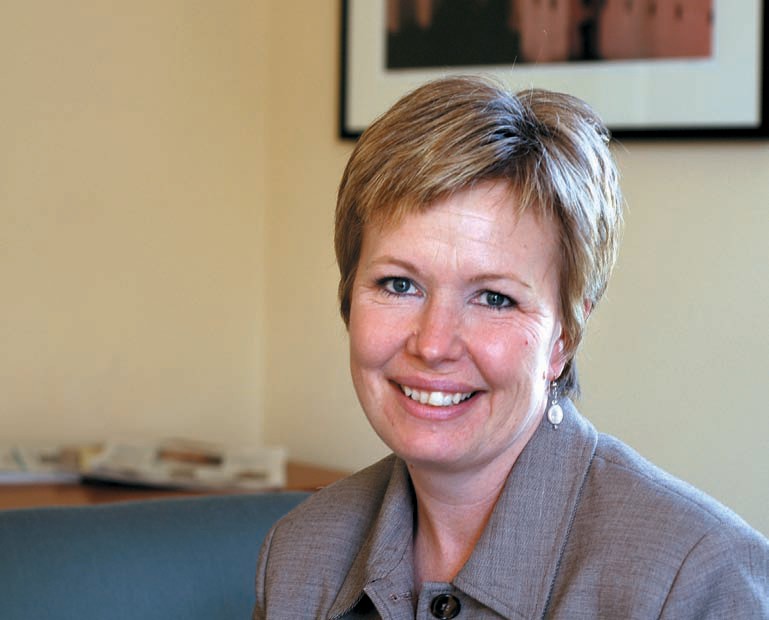
Photo Credit: Donald Tetto
When Pamela O’Neil PhD’91 talks about advancing the careers of women in science, she knows of what she speaks. O’Neil was on the faculty of the University of New Orleans for 15 years after receiving her PhD from the Department of Ecology and Evolutionary Biology.
Now associate provost for policy and planning at Brown, O’Neil is PI on a new $3.3 million grant from the National Science Foundation’s ADVANCE program aimed at increasing the representation and advancement of women in science and engineering academic careers. The grant announcement coincided with a report from a National Academies panel, of which President Ruth Simmons was a member, that found women are under-represented in academic leadership positions in science and mathematics not because they are innately less capable than men, but because of biases, discrimination, and institutional structures.
“For women scientists it’s not a comfortable thing to talk about,” O’Neil says. “Women scientists want to do science. As an administrator, I feel strongly that we need to tackle the institutional problems that keep women from being successful.”
Brown Medicine spoke with Associate Provost O’Neil about the grant and what it means for Brown.
What is an ADVANCE Institutional Transformation Award?
The idea is to give institutions awards so they can transform themselves into places where women are able to succeed at the highest level. The National Academies report showed that even though there are a lot of women in the pipeline, there aren’t as many at the full professor level. Because at Brown we have a president who was already dedicated to the recruitment of women, we decided to work a level higher and concentrate on retention.
What is the focus of the grant?
Faculty development programs—but not for women, because all faculty need help in order to be successful as they can be. This fits in with the Plan for Academic Enrichment and the idea that we want all Brown faculty to have the opportunity to be superstars. If we have fair, transparent faculty development programs, then women will succeed under that sort of system.
What do you mean by “transparent?”
Sometimes women feel that they don’t have access to the same resources that male faculty do. Often, that’s because access is informal. That’s where you have the lack of transparency. Women feel like if they ask for something it’s going to be seen as a special favor, and they don’t want to be seen as succeeding because of special favors. Resources should be available in a transparent way. Even if the effect in each case is small, the cumulative effect over a career can be substantial.
Can you describe a few of the specific initiatives funded by the grant?
There are two levels of mentoring, for instance. One will work with department chairs to develop a mentoring program within their department to help junior faculty meet the challenge of getting money from a national funding agency. Another will provide assistant professors with a mentor outside of their department if they would like one. Often because the people in your department will be the ones voting on you at tenure time, there’s a reluctance to voice concerns with them.
The grant will also provide funds for career development awards that will help faculty network with colleagues across the country and develop new collaborations.
For women who want a leadership role in an administrative position, we’d like to provide an opportunity for them to get experience. We’re not trying to make women who are scientists become administrators. We want there to be two very distinct leadership opportunities, because we recognize that the best way for women to be leaders is to be good scientists first.
The physical sciences saw a jump in women faculty hires. How are the life sciences doing?
The life sciences have been flat. If we just stay at 30 percent, is that really good enough when the pipeline suggests that we could be at 40 percent?