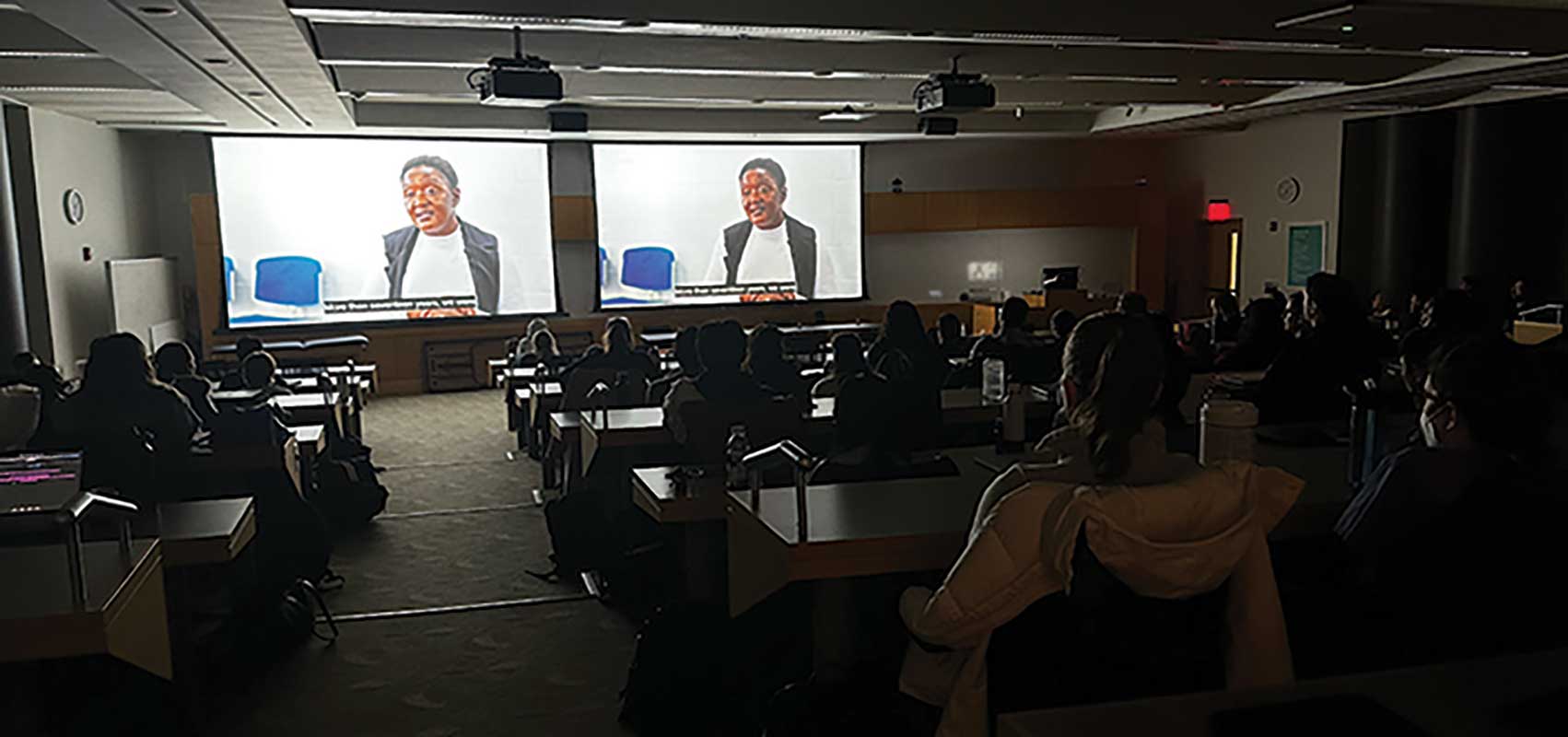
As refugee crises escalate around the world, one medical student wants to use his new documentary to help change how medical professionals approach trauma-informed care and making human connections.
Migration in Medicine, co-directed by Bazif Bala ’22 MD’26 ScM’26, tells the stories of three refugees—their journeys to the US, their efforts to learn a new language and culture, and their challenges finding health care. Bala says he was drawn to medicine for its humanitarian aspects, and making a film about vulnerable populations and trauma-informed care was a natural fit.
“You can’t treat anything your patient doesn’t feel comfortable sharing with you,” says Bala, who screened his film at the Medical School last fall as part of a half-day session on undocumented immigrant and refugee health care.
Bala’s experiences studying population-level health interventions and his interest in humanitarianism motivated him to examine the trauma-informed care curriculum at Brown. Early last year, he met with Steven Rougas MD’09 RES’13, assistant dean of medical education and director of the clinical curriculum, and Julia Noguchi, DrPH, MPH, director of community engagement and scholarships, to discuss potential revisions.
“I reviewed some literature and, even when we think of trauma-informed care, very little standards have been developed for it,” Bala says. “Many of them don’t even include the lived experiences of refugees themselves.”
Bala’s research showed that storytelling is a powerful way to humanize patients, particularly in a field where the focus can fall on hard data. “How are we going to platform providing care for an at-risk population without highlighting their stories?” Bala remembers thinking.
The project received plenty of essential help from his friend Sidra Alani, the film’s co-director and an undergraduate at Tufts University. Bala and Alani coordinated with the Refugee Dream Center in Providence, Women & Infants Hospital, and faculty including Professor of Pediatrics Carol Lewis RES’83, MD, founder and director of Hasbro Children’s Hospital’s Refugee Health Program.
In addition to the refugees’ personal stories, Migration in Medicine includes trauma-informed strategies from both medical professionals and patients, and guidance for creating safe spaces for uniquely vulnerable patients.
Alani says she found people’s stories meaningful and touching, especially moments in between filming. After one interview, a refugee sent her and Bala a painting she had made, simply because she enjoyed the conversation—and the human connection.
“That’s what matters to us at the end of the day, especially as a filmmaker,” Alani says. “That was her safe spot, and for her to share that with us was meaningful.”
Bala says the experience shed light on a disconnect between clinical interventions and the human experience. As the film unfolds, the refugees gradually open up about specific ways medical professionals made them feel comfortable with sharing their concerns and, at times, their traumatic experiences. Bala realized that a physician’s most valuable asset is their communication style and how they help their patients feel secure and heard.
“I think oftentimes we get wrapped up in our white coats, but if we can drop roles a little bit and engage more in conversation rather than a checklist, then we’re doing our patients a great service,” he says. “It’s an honor that they will allow you to listen to their story.”