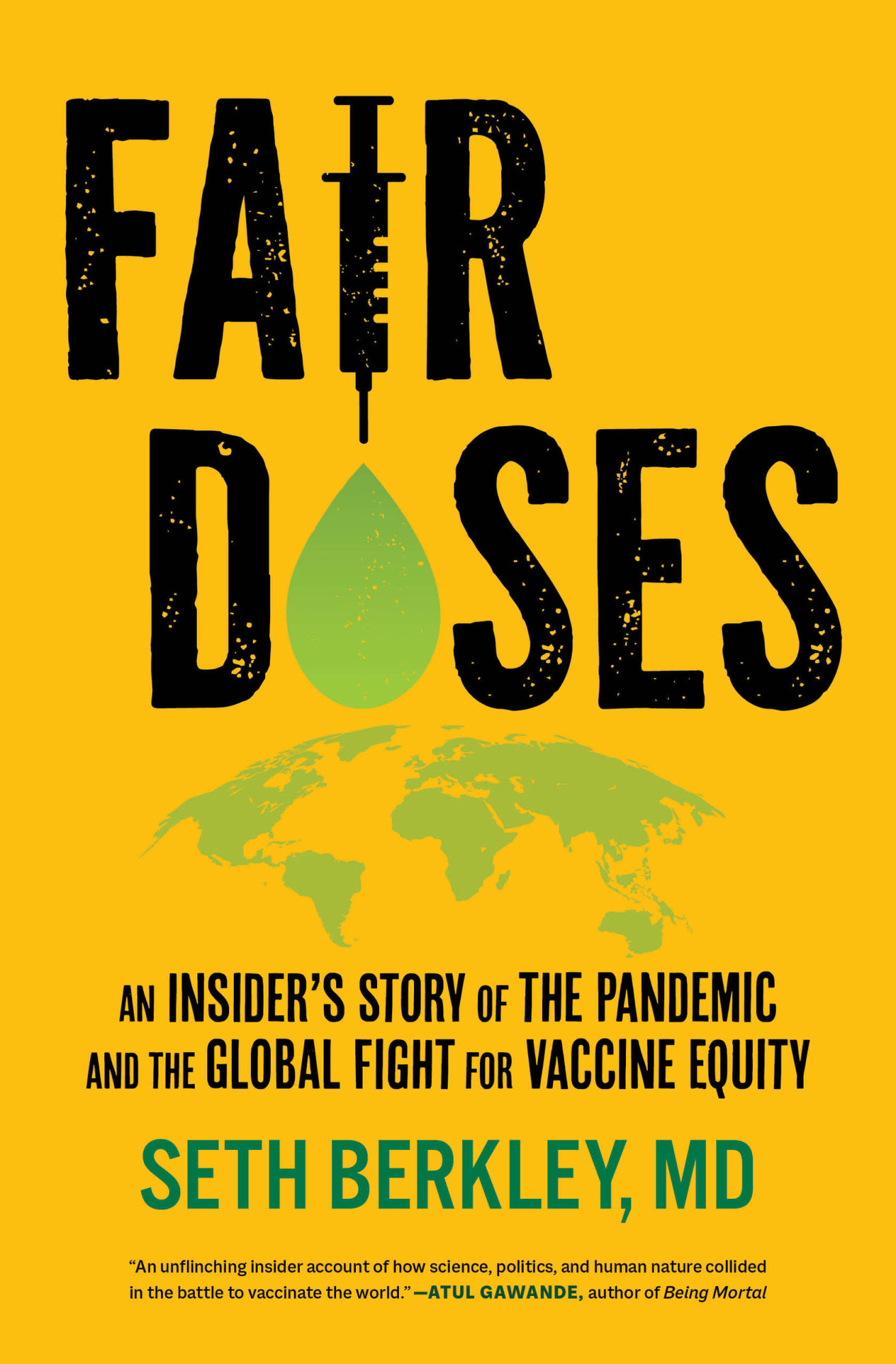
 Fair Doses: An Insider’s Story of the Pandemic and the Global Fight for Vaccine Equity
By Seth Berkley ’78 MD'81, P'27MD'31
University of California Press, 2025
Growing up in New York City, Berkley understood at a young age that he enjoyed a life of privilege. He went to Brown determined to become a doctor and make a difference; there, he writes, the founding dean of medicine Stanley Aronson, MD, “encouraged me to channel my energy toward equity.” After formative experiences in Mississippi, Brazil, and Senegal—where he traveled with Aronson—he steered his career toward tackling major public health challenges and the injustices that perpetuate them.
Again and again, as Berkley responded to international crises like famine and AIDS and Ebola, he saw how “distribution systems failed to work as they should, and people put profit and political expediency ahead of saving lives.” He tried to right those wrongs as the CEO of Gavi, the Vaccine Alliance, which provides vaccines at affordable prices for low- and middle-income countries. Though Berkley held that role for two decades before COVID-19 hit, his experiences could not prepare him for the magnitude of the pandemic—and the blowback when COVAX, the worldwide vaccine distribution initiative co-led by Gavi, did not meet all of its goals.
Berkley writes that “the hardest bit about saving people’s lives through vaccines isn’t always the science of developing and manufacturing them. It’s also the politics, economics, and logistics of getting the vaccines to the people who need them.” Much of Fair Doses recounts how COVAX helped accelerate the development of the COVID vaccine and signed up wealthy nations to bankroll its distribution in lower-income countries—and then how vaccine hoarding, production delays, export bans, and other complications thwarted those efforts. Ultimately, COVAX delivered almost 2 billion vaccines to 146 countries by the end of 2023—“the fastest rollout of vaccines to developing countries ever,” Berkley writes—but still short of their target of vaccinating 70 percent of humanity. “I still wish we, and the world, could have done better.”
Now an adjunct professor and senior adviser to the Pandemic Center at Brown’s School of Public Health, Berkley says he wrote Fair Doses partly to respond to criticisms of COVAX and Gavi, but also to debrief for the inevitable next time. He notes concerning recent outbreaks like mpox, avian flu, and Marburg, which demonstrate that “we need to make sure that all countries are prepared to do their part.” Yet the “historic” World Health Organization treaty adopted last year to improve future pandemic response lacks enforcement or funding mechanisms, he writes. The US, meanwhile, has almost completely turned its back on public health. “Are we prepared?” Berkley asks, more than once. For now, the answer is no.